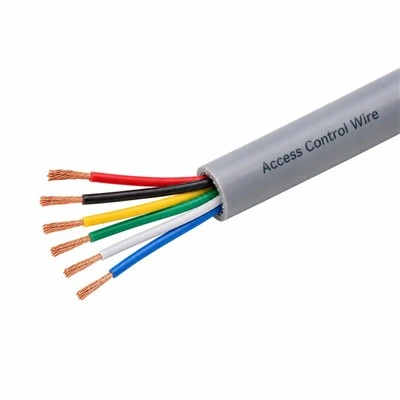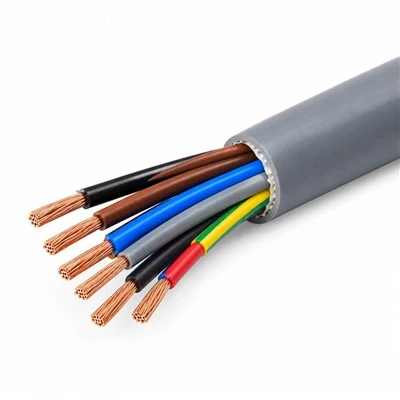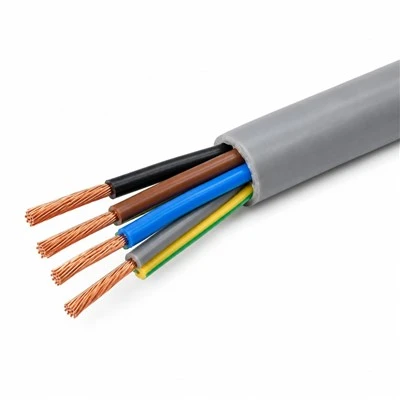
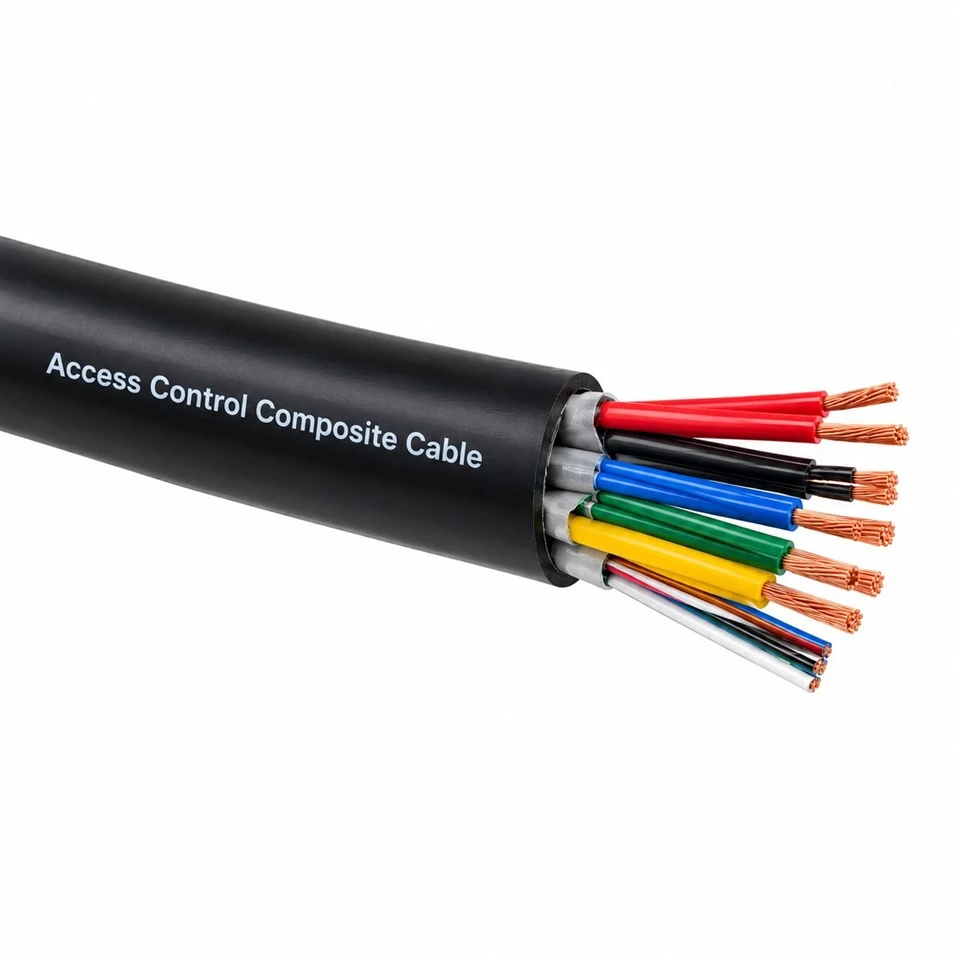
Installing an access control system often involves more than connecting a card reader to a controller. The same doorway may require reader power and data, an electronic lock circuit, a door position contact and a request-to-exit input. If every function is wired separately, the installation can involve numerous cable runs, more complicated routing and additional work when tracing connections during maintenance.
An access control composite cable can help organize these connections by combining different conductors or circuit elements within one overall cable assembly. Depending on the design, a composite cable may incorporate conductor groups intended for different functions, such as power, control signals or specified communication circuits. The exact arrangement must be confirmed from the product construction drawing and the connected equipment requirements.
For security system integrators, electrical contractors, building automation companies and access control equipment distributors, the main benefit is not simply having multiple conductors in one jacket. It is having a cable construction that matches the intended circuits, simplifies the planned route and supports consistent installation across a project.
What Is an Access Control Composite Cable?
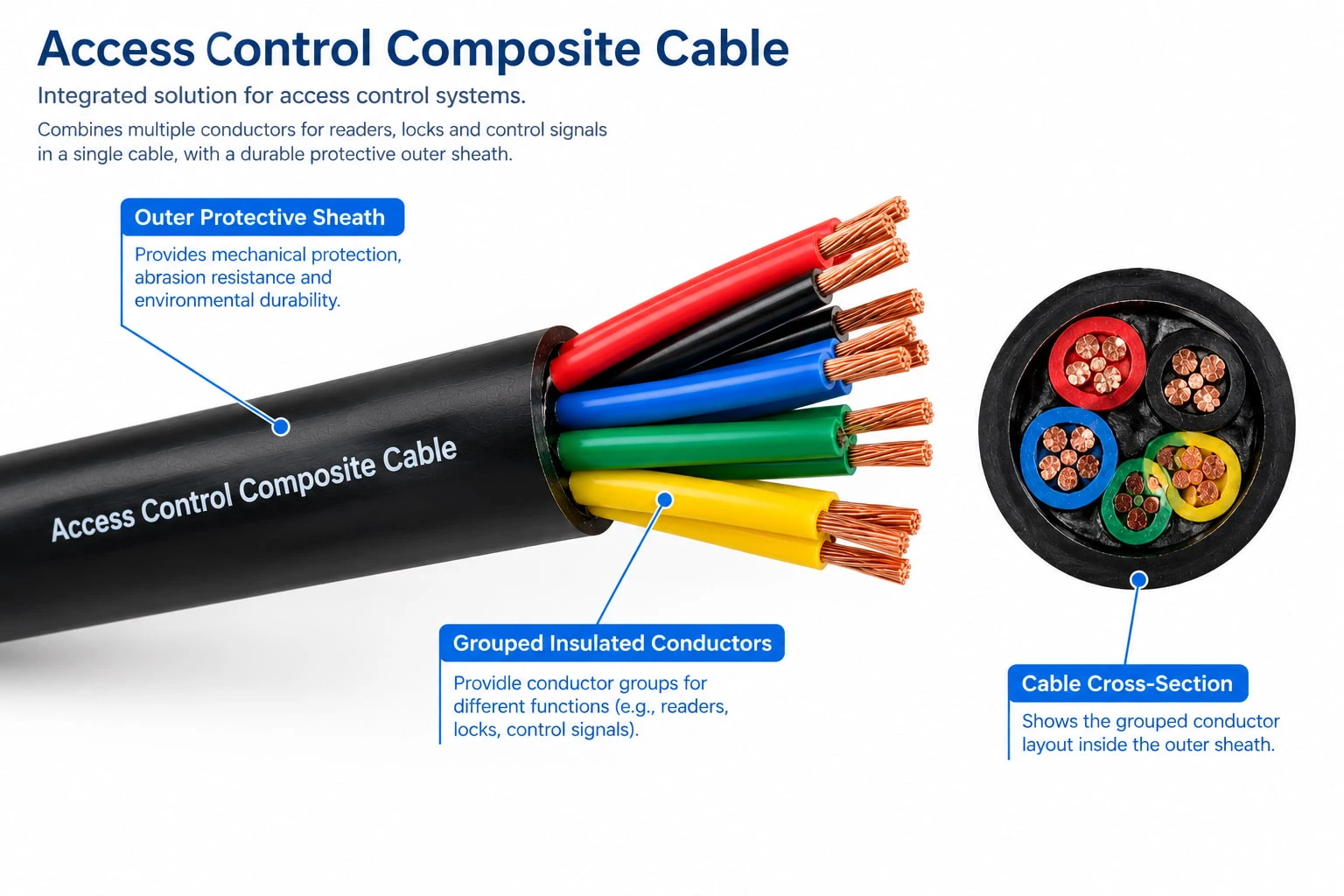
An access control composite cable is a cable assembly designed to combine multiple conductor groups or cable elements for use in an access control or security system. Instead of treating every circuit as a completely independent cable route, a composite construction can bring compatible connections together within one organized assembly.
The term composite cable does not define one universal conductor arrangement. One design may combine several groups of insulated conductors, while another may include a combination of conductor types or shielding arrangements. The number of cores, conductor sizes, insulation materials, shields and overall sheath depend on the specific product design.
This distinction matters when specifying the cable. A product described as an access control composite cable should not automatically be assumed to contain dedicated reader, lock and sensor circuits in a particular configuration. Buyers should confirm which conductors are included, how the groups are arranged and whether the construction is suitable for the intended equipment.
In practical terms, the cable should be selected from the system's wiring schedule, not from the product name alone.
How Composite Cable Supports Access Control Wiring
A typical door access installation contains several electrical functions. They may operate together at the same doorway, but they do not necessarily share the same electrical requirements.
Reader Power and Data
A card reader or keypad may require a power connection and a defined data interface to communicate with an access control panel. The actual wiring depends on the reader technology and the interface specified by the manufacturer.
Some reader circuits use defined data conductors, while other systems use a specified communication cable or network connection. A composite cable is appropriate only when the relevant conductor group meets the interface requirements, including any applicable transmission characteristics, distance limitations and shielding requirements.
Where the reader manufacturer specifies a particular cable type, that requirement takes priority over the general description "composite cable."
Electronic Lock Power and Control
Electric strikes and electromagnetic locks can impose different electrical loads from readers and monitoring devices. Their wiring must be sized for the actual load and cable length, taking into account allowable voltage drop and the lock's required operating voltage.
Combining lock conductors with other circuit groups can help organize the cable route, but it does not eliminate the need to size the conductors correctly. A long run to a powered lock may require a larger conductor cross-section than a low-current status circuit. If the composite construction does not provide a suitable conductor group, the lock circuit may need a separate cable.
Door Position Monitoring
Door position sensors or magnetic contacts report whether a door is open or closed. These monitoring circuits typically have different requirements from a lock's power circuit. The selected conductor group must match the contact arrangement and the controller input configuration.
Including monitoring conductors in a composite cable can make the overall route easier to organize when the cable construction and installation conditions are suitable. The conductors should still be identified clearly at both ends to support commissioning, fault tracing and future maintenance.
Request-to-Exit and Auxiliary Signals
Request-to-exit buttons, door release interfaces and other auxiliary devices may also require connections to the access control panel. Their conductor requirements depend on the equipment and system design.
Before choosing a composite cable, list the required circuits for each doorway. If a door requires reader power and data, lock power, door monitoring and an exit input, confirm that the proposed construction provides the necessary conductors and that each group is suitable for its assigned function.
Where Is Access Control Composite Cable Used?
Commercial Offices and Building Entrances
Office buildings often have controlled entrances, internal restricted areas and multiple doors connected to a centralized security management system. A composite cable can be considered where several compatible door-level circuits follow the same route between field devices and a controller or junction point.
For projects with many doors, a consistent cable schedule can help standardize installation. The cable specification should identify the conductor groups, destination devices and any differences between ordinary access doors, high-security areas and emergency exits.
Warehouses and Industrial Facilities
Warehouses, manufacturing plants and distribution centers may use access control at personnel entrances, equipment rooms, inventory areas and restricted production zones. Cable routes can pass through conduits, cable trays, ceiling spaces and equipment enclosures.
In these environments, the choice of sheath and installation method deserves attention. Cable routes may be exposed to vibration, accidental impact, dust, moisture or industrial cleaning activities. The selected construction must be suitable for the actual exposure, and additional mechanical protection may be required.
Hotels, Campuses and Multi-Door Facilities
Hotels, educational campuses, healthcare buildings and other multi-door facilities may have repeated access control configurations across numerous openings. Where the same device combination is used repeatedly, a suitable composite cable can help reduce variation in the installation schedule.
Not every door will use the same circuits. Some may include only a reader and door contact, while others may require an electronic lock, exit device or additional monitoring. Cable quantities and configurations should therefore be based on the actual door schedule rather than assuming one design fits every opening.
Integrated Security and Building Management
Some buildings integrate access control with other systems, such as door monitoring, alarms or building management. Although these systems may be coordinated at the software level, their wiring requirements can differ significantly.
A composite cable should be used only where its conductor characteristics and construction are compatible with each intended circuit. Fire alarm circuits, life-safety functions and specified data networks may be subject to separate cable and installation requirements. Do not assume that combining circuits in one jacket automatically makes the cable suitable for every integrated system.

How to Specify the Right Composite Cable
1. Prepare a Door-Level Wiring Schedule
Start with the devices installed at each door. Record the reader type, lock type, door contact, exit device and any additional monitoring or communication functions. Then identify the connections required by each device's wiring diagram.
This step establishes how many conductors are needed and which circuits must be kept separate. It also reveals whether a single composite cable can serve the planned connection or whether a dedicated cable is required for a particular device.
2. Match Each Conductor Group to Its Circuit
Conductor count alone is not enough. The selected group must also have a suitable conductor size, insulation and electrical performance for its intended function.
For example, reader data, low-current monitoring and lock power may have different requirements. Assigning all of them to identical conductors without checking the equipment specifications can result in poor performance or an unsuitable installation.
Where a composite cable combines several circuit types, request a construction drawing that identifies each group and its intended characteristics. This is particularly important when the cable is being purchased for a large project or a standardized installation package.
3. Check Voltage Drop on Powered Circuits
For electronic locks and other powered devices, verify the expected voltage at the equipment under the relevant load conditions. Voltage drop depends on conductor resistance, circuit current, cable length and the wiring arrangement.
Do not size the entire composite cable only around the smallest signal circuit. The conductor group serving the lock must meet the lock manufacturer's requirements, even when the remaining conductors carry low-current signals.
4. Confirm Communication and Shielding Requirements
Some access control interfaces specify cable characteristics beyond the number of conductors. Depending on the interface, these may include conductor arrangement, transmission performance, shielding and maximum permitted cable length.
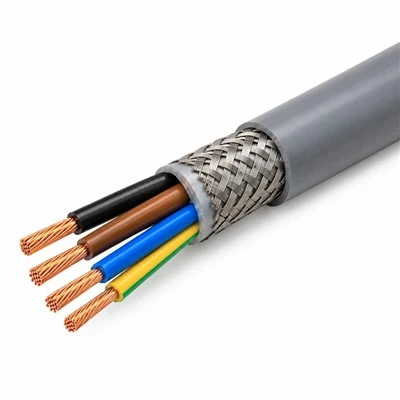
If the system requires a screened cable, verify how the shield is constructed and how it should be terminated. Also follow the equipment manufacturer's instructions for separating signal wiring from noisy power circuits. A shielded construction should not be assumed to replace correct routing or grounding practices.
For installations that need screening, compare the actual requirements with Huawang's shielded control cable options. The product must still be checked against the specific access control interface before use.
5. Select the Sheath for the Installation Environment
The outer sheath should suit the cable route and the expected exposure. An indoor route within protected building spaces may have different requirements from an outdoor gate, exposed perimeter installation or industrial area where the cable could encounter oil, chemicals, sunlight or mechanical damage.
Where the project specifies low-smoke or halogen-free materials, review the relevant LSZH control cable range and verify the exact product's documented properties. Where mechanical protection is needed, assess the complete cable route and determine whether a protected pathway or a different cable construction is required.
6. Consider Installation, Identification and Maintenance
Composite cable can simplify routing, but only when installers can identify the individual conductor groups and terminate them correctly. The cable schedule should map each conductor or group to its destination and function.
Confirm the cable's outer diameter, bending requirements, entry hardware compatibility and termination space. If the cable will pass through a moving door transition or other frequently flexed section, verify that the construction is suitable for the expected movement. A composite cable intended for fixed installation should not automatically be used for continuous flexing.
Access Control Composite Cable vs. Separate Cables
Composite cable is not always the best choice. The decision depends on whether the circuits share a route, whether their electrical requirements are compatible and whether the combined construction provides the necessary conductor groups.
| Consideration | Composite cable | Separate cables |
|---|---|---|
| Routing | Can consolidate compatible circuit groups in one overall assembly | Allows each circuit to follow an independent route |
| Conductor configuration | Must match the required circuit combination | Each cable can be selected for its individual function |
| Signal requirements | All included groups must meet their respective requirements | Specialized cable can be chosen for each signal or interface |
| Installation planning | May simplify routing where devices share a pathway | May provide greater flexibility when circuits have different routes |
| Maintenance | Clear conductor identification is essential within the combined assembly | Individual cables may be easier to isolate by circuit, depending on labeling |
| Project suitability | Useful when the combination is technically compatible and specified | Preferable where circuit separation or a dedicated cable type is required |
The right choice is the construction that meets the electrical specification and makes installation manageable. Combining circuits should never take priority over the communication requirements, safety rules or operating needs of the connected devices.
Technical Information to Confirm Before Ordering
Because access control composite cable can refer to different conductor arrangements, buyers should request the exact construction details before comparing quotations.
| Specification | Information to confirm |
|---|---|
| Cable construction | Overall structure and number of conductor groups |
| Conductor configuration | Core count, group arrangement and conductor identification |
| Conductor material and size | Material and cross-sectional area for each required group |
| Conductor class | Solid or stranded construction, as specified |
| Insulation material | Material and electrical or temperature requirements |
| Shielding | Whether any group or the complete cable requires a shield |
| Outer sheath | Material, color if specified, and environmental requirements |
| Electrical ratings | Rated voltage and any relevant circuit-specific requirements |
| Applicable standards | Equipment specifications, project requirements and required approvals |
| Installation conditions | Indoor or outdoor use, fixed or moving route, and mechanical protection |
| Packaging and supply | Required length, quantity, reel or coil format and delivery destination |
These are purchasing and engineering checks, not claimed Huawang product specifications. Actual construction details, available configurations and performance ratings must be confirmed against the specific product drawing and datasheet.
Quality Documentation and Project Verification
For security system integrators and project contractors, the cable should be supported by technical information that matches the offered construction. Depending on the specification, buyers may need conductor data, cable dimensions, material information, test records or other documentation required for acceptance.
Where a project requires a particular certification, fire-performance classification or installation approval, identify it before ordering and verify that the exact cable construction satisfies the requirement. A general claim that a cable is intended for security systems is not a substitute for project-specific documentation.
For repeat installations, it is also useful to keep the product description, construction drawing, conductor identification and cable schedule consistent across the purchase order, packaging labels and installation records. This reduces ambiguity when the cable is received, installed or reordered.
Packaging and Supply Planning
Access control projects may involve many doors and different circuit configurations. Clear packaging and product identification can help installers distinguish the correct cable type and length for each work package.
When preparing a purchase order, specify the complete cable construction, quantity, required length, reel or coil preference, labeling requirements and delivery destination. For larger projects, separate line items should be used wherever different conductor configurations or cable constructions are required.
Available packaging formats, minimum order quantities, lead times and supply arrangements should be confirmed for the actual product and order. They should not be inferred from the term "composite cable."
Frequently Asked Questions
What is an access control composite cable?
It is a cable assembly that combines multiple conductor groups or cable elements for compatible access control or security system connections. The exact conductor arrangement and performance depend on the product design.
Can one composite cable connect a card reader and an electronic door lock?
Potentially, if the cable contains suitable conductor groups for both devices and meets their electrical, communication and installation requirements. Check the reader and lock documentation before selecting the construction.
Does access control composite cable include shielding?
Not necessarily. Shielding depends on the product design and circuit requirements. Confirm whether the cable or any individual conductor group is screened, and follow the applicable termination instructions.
Can composite cable be used for every access control protocol?
No. Communication interfaces may specify particular cable characteristics, transmission performance or permitted cable lengths. The proposed construction must be checked against the equipment manufacturer's requirements.
Is composite cable always better than separate cables?
No. Composite cable can simplify routing when compatible circuits share a pathway, but separate cables may be more appropriate when circuits require different cable types, independent routing or specific electrical characteristics.
What information is needed for a quotation?
Provide the wiring schedule or device list, required conductor groups, conductor sizes, shielding requirements, sheath requirements, applicable standards, cable lengths, quantities, packaging preferences and delivery destination. A wiring diagram helps clarify the intended construction.
An access control composite cable should be selected as part of the complete door wiring design. When the conductor groups match the connected devices and the installation conditions, a combined cable assembly can make routing more organized without compromising circuit requirements. A clear construction specification is the best starting point for comparing products and planning a reliable installation.
Hot Tags: access control composite cable manufacturer、composite cable for access control、access control system cable、door access control cable、security system composite cable、card reader and door lock cable、access control wiring cable, 12 core control cable, 3 core control cable, cables and controls, control cable, multi core control cable, power control cable