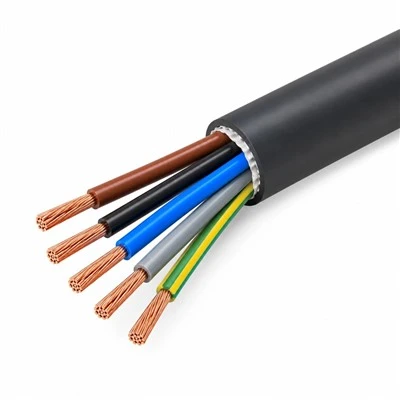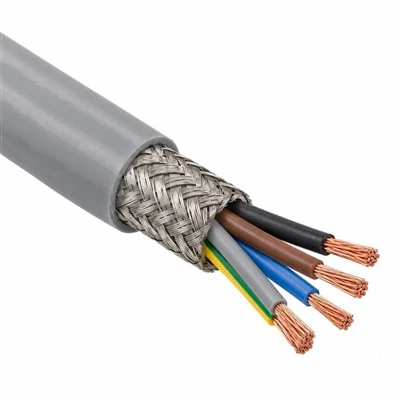
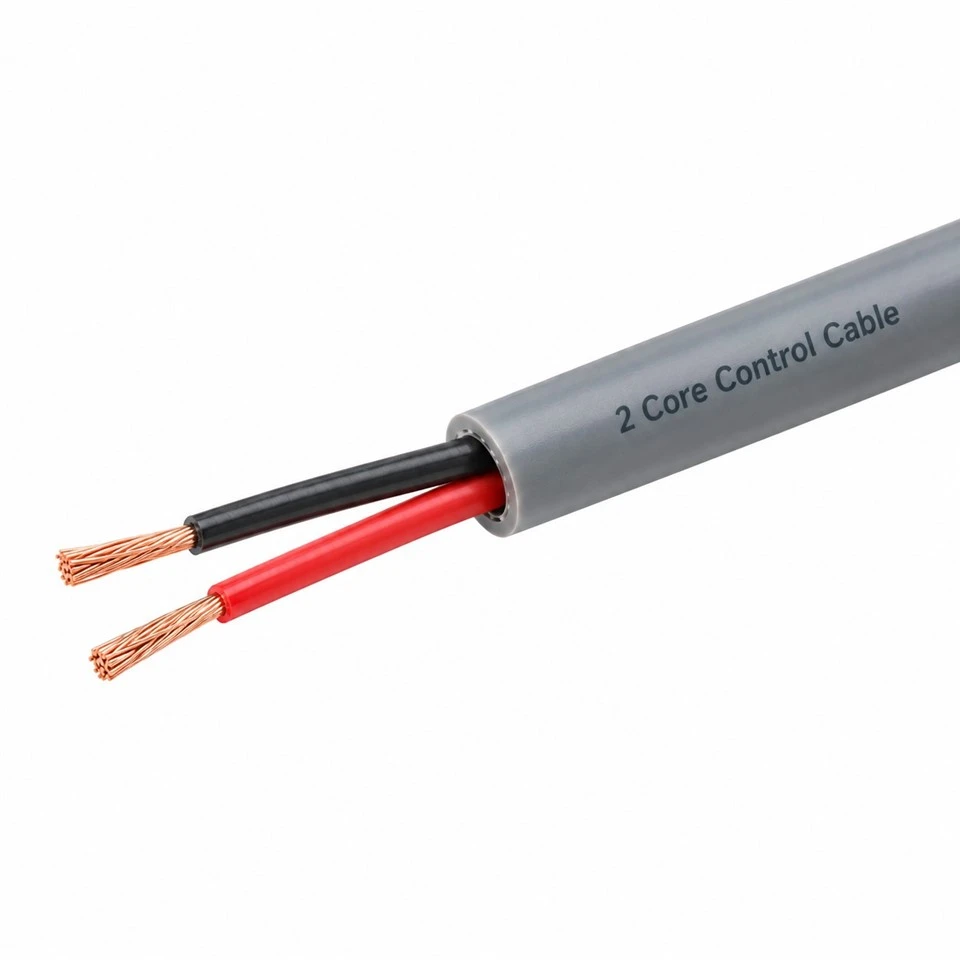
A two-core control cable is often selected when an electrical circuit needs two conductors and a larger multicore cable would add unnecessary wiring complexity. Typical examples include certain switching circuits, equipment status signals and connections between control components. However, the right cable depends on more than the number of cores: conductor size, insulation, sheath material, rated voltage and installation conditions must all match the application.
For machine builders, electrical contractors and industrial distributors, a 2 core control cable can be a practical option for compact control circuits and auxiliary wiring. The important step is to establish what the two conductors will carry, where the cable will be installed and whether the circuit requires any additional protection, such as screening, enhanced mechanical protection or a special fire-performance rating.
Huawang Cable provides cable solutions for industrial electrical applications. The final construction of a two-core control cable should be confirmed against the required technical specification rather than inferred from the product name alone.
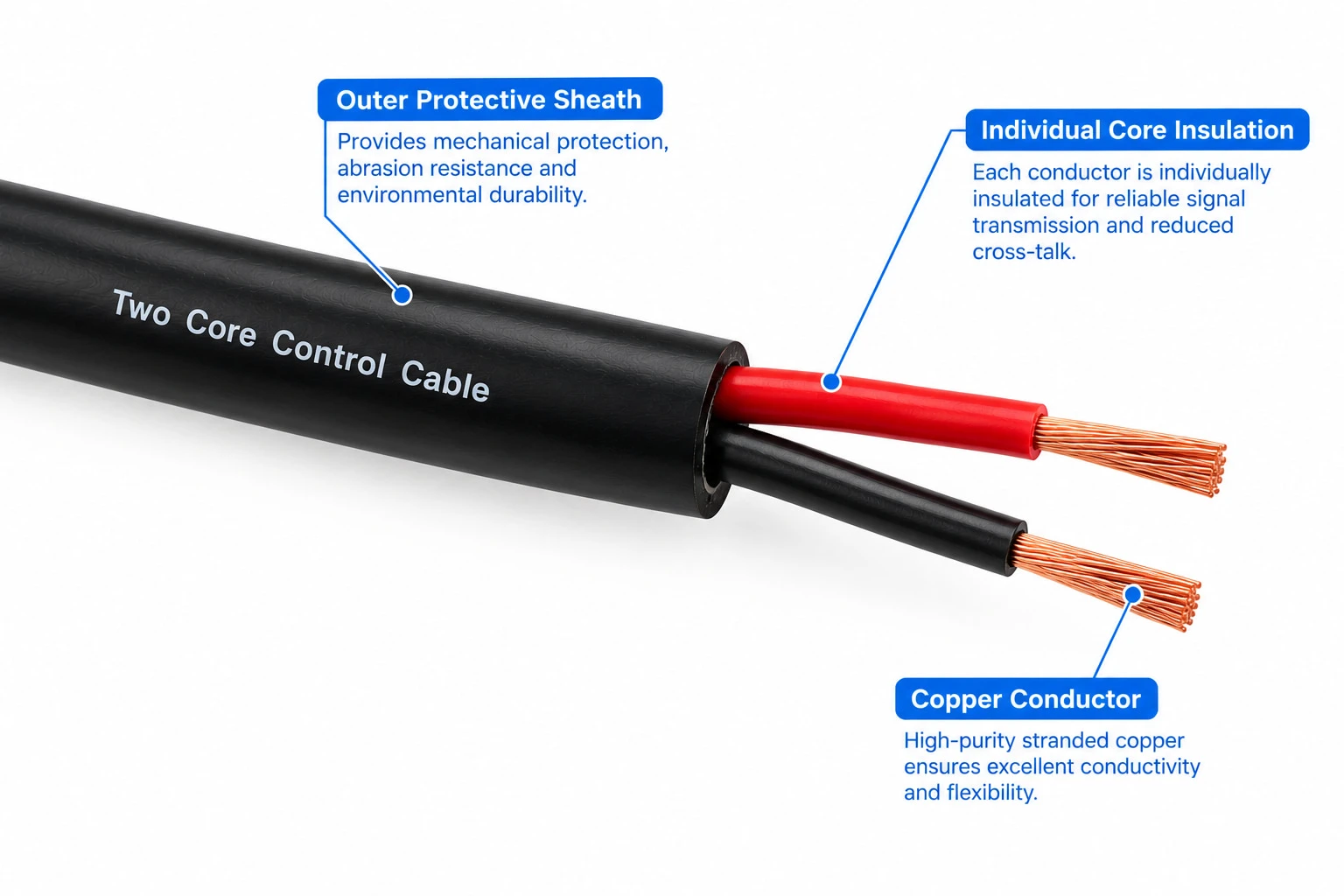
What Is a 2 Core Control Cable?
A 2 core control cable contains two insulated conductors within a shared cable construction. Depending on the design, the conductors may be stranded or solid, and the cable may use different insulation and outer sheath materials to meet its intended electrical and environmental requirements.
Two-core construction is useful when a circuit requires two conductors for its intended function. For example, some simple switching or status circuits use a pair of conductors between a field device and a control system. Other applications may use two conductors for a defined signal circuit or an auxiliary control connection.
That does not mean every two-wire circuit can use the same cable. Some sensors require specific wiring arrangements, certain signals need screened cable, and communication systems may require a cable with defined impedance or transmission characteristics. A two-core control cable should only be used when its construction and documented performance are compatible with the connected equipment.
Where Is 2 Core Control Cable Used?
1. Switching and Status Circuits
Two-core cables can be used for suitable switching and status circuits, including connections involving limit switches, contact devices and other field components. In these applications, the two conductors provide the electrical path required by the circuit design.
When planning the installation, check the circuit diagram rather than relying on the device name alone. Some devices require additional conductors for power, separate outputs or monitoring functions. A two-core cable is appropriate only when the required connections can be accommodated by the available conductors.
2. Industrial Machinery and Auxiliary Wiring
Machine tools, packaging equipment and production machinery contain many small control circuits alongside their main power wiring. A two-core control cable may suit selected auxiliary connections where two conductors are sufficient and the cable's rating matches the machine specification.
Routing is important. A cable installed inside a protected machine enclosure experiences different conditions from one exposed to abrasion, oil, vibration or repeated movement. Where a cable passes through moving machine sections, verify that it is designed for the required bending and movement duty. A general-purpose cable should not be assumed suitable for continuous flexing.
3. Sensors and Instrumentation
Some field devices use two-wire connections for defined sensing or monitoring functions. The cable must be compatible with the device's electrical requirements, including its wiring arrangement, signal characteristics and any installation instructions provided by the equipment manufacturer.
For low-level analogue signals or installations near sources of electromagnetic interference, evaluate whether screening is necessary. A standard unscreened two-core cable is not automatically the correct choice for every sensor. For relevant applications, compare the requirements with Huawang's shielded control cable options.
4. Pumps, Valves and Auxiliary Equipment
Industrial pump assemblies, valve systems and auxiliary equipment may contain two-conductor control circuits for particular switching, monitoring or actuation functions. The suitability of a two-core cable depends on the device's electrical design and the cable route.
Where the cable is installed around water treatment equipment, chemical processing areas or washdown zones, confirm the sheath's resistance to the actual environmental exposure. Proximity to moisture or chemicals does not automatically make a standard cable suitable for that service.
5. Building Services and General Electrical Control
Selected building-service installations use two-conductor cables for control functions in compatible equipment. However, ordinary control wiring must be distinguished from fire alarm circuits, emergency systems and communication links governed by specific project standards or regulations.
Before using a two-core control cable in a building system, check the local electrical code, system specification and equipment manufacturer's requirements. A cable intended for general control wiring should not be substituted for a specially specified cable without verification.

How to Select the Right Two Core Control Cable
Conductor Material and Cross-Section
Conductor material and cross-sectional area influence electrical resistance, current-carrying capability and voltage drop. The correct size depends on circuit current, cable length, installation method, ambient conditions and applicable design requirements.
For a low-current status signal, the conductor requirements may differ from those of a circuit operating an actuator or other electrical load. Long cable runs can also make voltage drop more significant. Buyers should therefore specify the actual circuit requirements rather than selecting conductor size based only on the cable's physical appearance.
Conductor Class and Flexibility
The required conductor class depends on how the cable will be installed and used. A fixed installation may have different requirements from a connection that is repositioned during maintenance or subjected to repeated movement.
If the application requires greater flexibility, check the conductor construction, minimum bending radius and any stated movement limitations. Huawang's flexible control cable range provides a useful comparison for applications where cable handling and movement are key considerations.
Insulation and Outer Sheath
Insulation must be suitable for the circuit's rated voltage and operating conditions. The outer sheath protects the cable assembly from the environmental and mechanical conditions anticipated in the installation. Different materials offer different properties, so buyers should verify the actual material specification rather than assume that every two-core control cable has the same performance.
For example, a cable inside a clean electrical enclosure may have different requirements from one routed outdoors or exposed to oil, chemicals, ultraviolet radiation or elevated temperatures. Where low-smoke or halogen-free performance is specified, review Huawang's LSZH control cable range and confirm the relevant documented performance.
Shielding and Electrical Noise
Not every two-core control cable needs a shield. The decision depends on signal type, electromagnetic interference, cable routing and the requirements of the connected equipment. A shielded construction may be appropriate where sensitive signals must be protected from interference, but the installation and termination method also affect performance.
When screening is required, confirm the shield construction and grounding instructions. Do not assume that a cable with two insulated conductors is automatically shielded or suitable for every analogue signal or communication application.
Mechanical Protection and Installation Route
Cable routes can expose conductors to crushing, abrasion, vibration or accidental impact. Where the installation requires additional mechanical protection, the cable construction and installation method should be reviewed together. Depending on the project, protective conduit, cable tray design or an appropriately specified armoured cable may be required.
For installations where armour is part of the specification, compare the application with Huawang's steel tape armoured cable range. The appropriate construction depends on the actual mechanical risk and applicable installation rules.
Technical Parameters to Confirm Before Ordering
The following table lists the main details that should be established before a two-core control cable is specified or quoted. Values must come from the actual product datasheet or an approved technical specification.
| Parameter | What to specify or verify |
|---|---|
| Number of cores | 2 cores |
| Conductor material | Confirm copper or another specified conductor material |
| Conductor cross-section | Specify the required area in mm² based on the circuit design |
| Conductor class | Confirm solid or stranded construction and the required conductor class |
| Rated voltage | Verify the value stated in the product datasheet and applicable standard |
| Insulation material | Confirm the specified insulation material and temperature rating |
| Outer sheath material | Confirm the sheath material and environmental suitability |
| Shielding | Specify whether screening is required and identify the required construction |
| Armour or additional protection | Confirm whether mechanical protection is required for the installation |
| Applicable standard | Identify the required product standard, project specification and approvals |
| Packaging and delivery | Specify cable length, reel or coil requirements, quantity and delivery destination |
These are selection fields, not claimed factory specifications. The final datasheet should provide the verified values for the exact cable construction being offered.
Product Construction and Core Identification
The two insulated conductors are housed within the cable's overall construction, which may include additional layers depending on the design. The exact arrangement should be confirmed using the product drawing or construction specification.
Core colours and identification methods can vary by product design and applicable standard. Buyers should not assume a universal colour combination. Where conductor identification is important for installation and maintenance, specify the required colour coding or numbering system when ordering.
Installation Considerations for Two Core Control Cable
Correct cable selection is only part of a reliable installation. The routing and termination details also affect service performance.
- Check circuit compatibility: verify the cable's rated voltage, conductor size and construction against the circuit design.
- Respect the bending radius: avoid sharp bends that may damage the insulation or cable structure.
- Protect the cable route: use suitable supports, conduit or other protection where the installation exposes the cable to mechanical damage.
- Separate circuits where required: follow the equipment manufacturer's instructions and applicable rules for routing control wiring alongside power cables.
- Use appropriate terminations: ensure the conductor size and construction are compatible with the terminals, ferrules or connectors used.
- Inspect before energizing: verify conductor identification, termination quality and any required electrical tests in accordance with the installation procedure.
Quality Verification and Documentation
For industrial procurement, product quality should be supported by appropriate technical documentation rather than broad claims alone. Depending on the applicable product standard and purchase specification, buyers may need construction details, conductor resistance data, dimensional information, routine test records or other inspection documentation.
Before placing an order, confirm which tests and documents are available for the exact product. If a project requires specific certification, fire-performance classification or third-party approval, identify the requirement at the quotation stage and verify that the offered construction meets it.
Any quality-control photograph used on this page should represent a real Huawang Cable inspection process or an accurately identified illustrative scene. Do not present a generic laboratory image as proof that a particular product has passed a specific test.
Packaging and Supply Information
Packaging requirements affect transport, storage, installation planning and material handling. For two-core control cable orders, buyers should confirm the required total length, preferred reel or coil format, individual cut lengths and cable identification requirements.
For projects involving multiple cable sizes or constructions, a clear itemized schedule helps reduce confusion during receiving and installation. Each line item should identify the core count, conductor cross-section, required construction, quantity and any applicable standard.
Actual reel sizes, packing methods, minimum order quantities and production lead times should be confirmed with Huawang Cable for the specific order. They should not be inferred from the product name.
Why Choose the Right 2 Core Control Cable?
A two-core construction can simplify wiring where only two conductors are required, but choosing the correct cable still calls for a careful review of the circuit and installation. The goal is to avoid both under-specification and unnecessary construction features.
- Match the core count to the actual wiring diagram.
- Select the conductor size based on electrical requirements and cable length.
- Confirm insulation and sheath materials for the intended environment.
- Evaluate shielding, flexibility and mechanical protection only where the application requires them.
- Confirm the applicable standard, technical documentation and delivery requirements before ordering.
For related product options and different cable constructions, explore the Huawang Cable control cable range. Selecting a cable according to verified technical requirements helps ensure that the product matches the intended circuit and installation conditions.
Frequently Asked Questions
What is a 2 core control cable used for?
It is used for compatible electrical control circuits that require two conductors. Applications may include selected switching, status, auxiliary equipment and sensor connections, subject to the device wiring requirements and cable specification.
Does a 2 core control cable have a shield?
Not necessarily. Shielding is a construction feature that must be specified when required. Confirm the product drawing or datasheet to determine whether the cable includes screening.
Can a 2 core control cable be used for sensors?
Some sensors use two-wire connections, but compatibility depends on the sensor's wiring arrangement, signal type, electrical requirements and installation environment. Check the device documentation before selecting the cable.
Is a 2 core control cable suitable for moving machinery?
Only if the cable is designed and rated for the expected movement. Continuous flexing, torsion and drag-chain applications require verification of the cable's movement capability, conductor construction and minimum bending radius.
How do I choose the correct conductor size?
Consider circuit current, cable length, allowable voltage drop, installation conditions and the applicable electrical design rules. The appropriate size should be determined from the circuit requirements rather than core count alone.
What information is needed for a quotation?
Provide the two-core configuration, conductor material and cross-section, rated voltage, insulation and sheath requirements, shielding or armour needs, applicable standards, quantity, cable lengths, packaging preference and delivery destination.
A 2 core control cable is a practical option for suitable two-conductor circuits, provided that the cable construction matches the electrical and environmental demands of the installation. Clear technical requirements help buyers compare products accurately, avoid unsuitable substitutions and plan procurement with greater confidence.
Hot Tags: 2 core control cable manufacturer、2 core industrial control cable、2 core electrical control cable、2 core multicore cable、2 core control cable applications、two core control cable、2 core flexible control cable, 4 wire control cable, Aluminium Tape Shielded Cable, armored control cable, Copper Tape Shielded Cable, Fire Rated Control Cable, temperature control cable