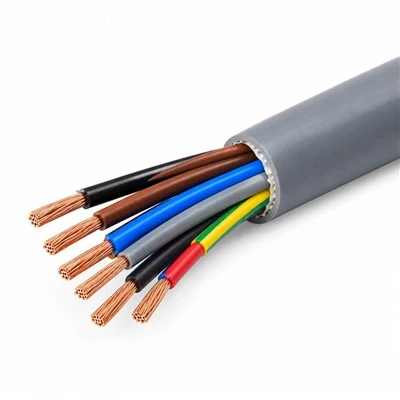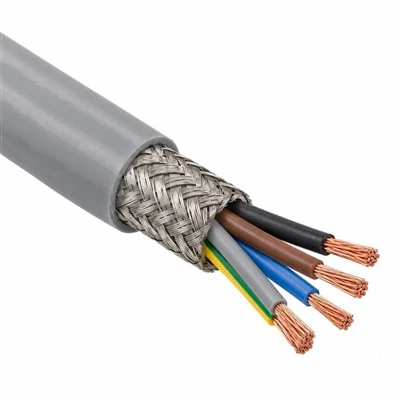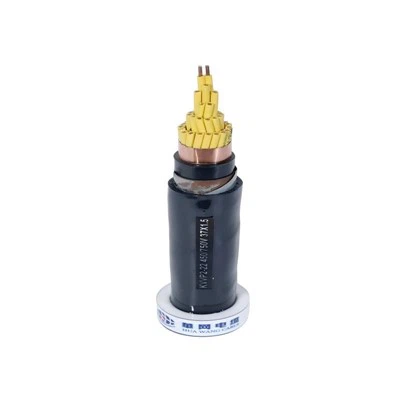
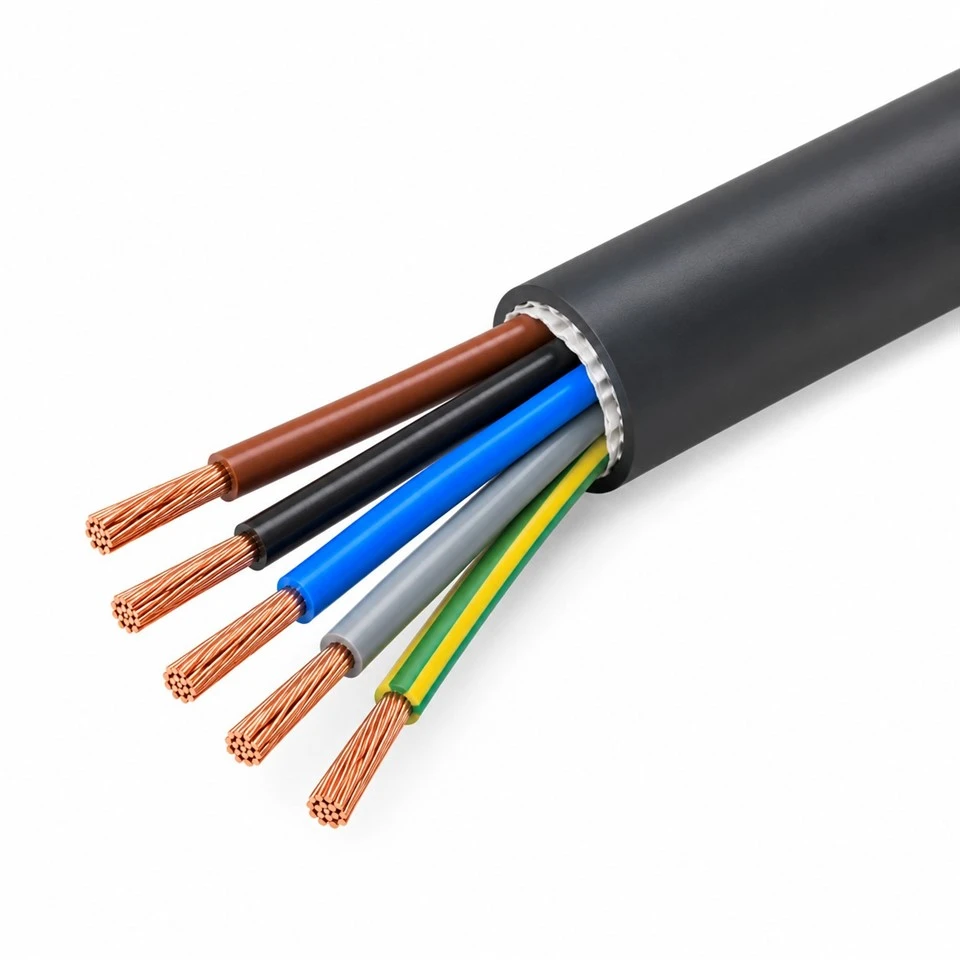
Electrical control cable is used to connect the components that operate, monitor and coordinate industrial electrical equipment. These connections may run between a control cabinet and a machine, link field sensors to a controller, or carry switching and status signals between separate parts of an electrical system.
Although these cables may look similar from the outside, their suitability depends on what the circuit must do. A cable for stationary relay wiring does not necessarily meet the requirements of a moving machine, a signal circuit exposed to electromagnetic interference, or an installation requiring additional mechanical protection. Selecting the right electrical control cable starts with understanding the circuit, then matching the cable construction to its operating conditions.
Huawang Cable offers a range of industrial cable products for different control and equipment-connection requirements. The appropriate product for a specific project should be confirmed against its conductor configuration, electrical rating, insulation and sheath materials, installation method and applicable standards.
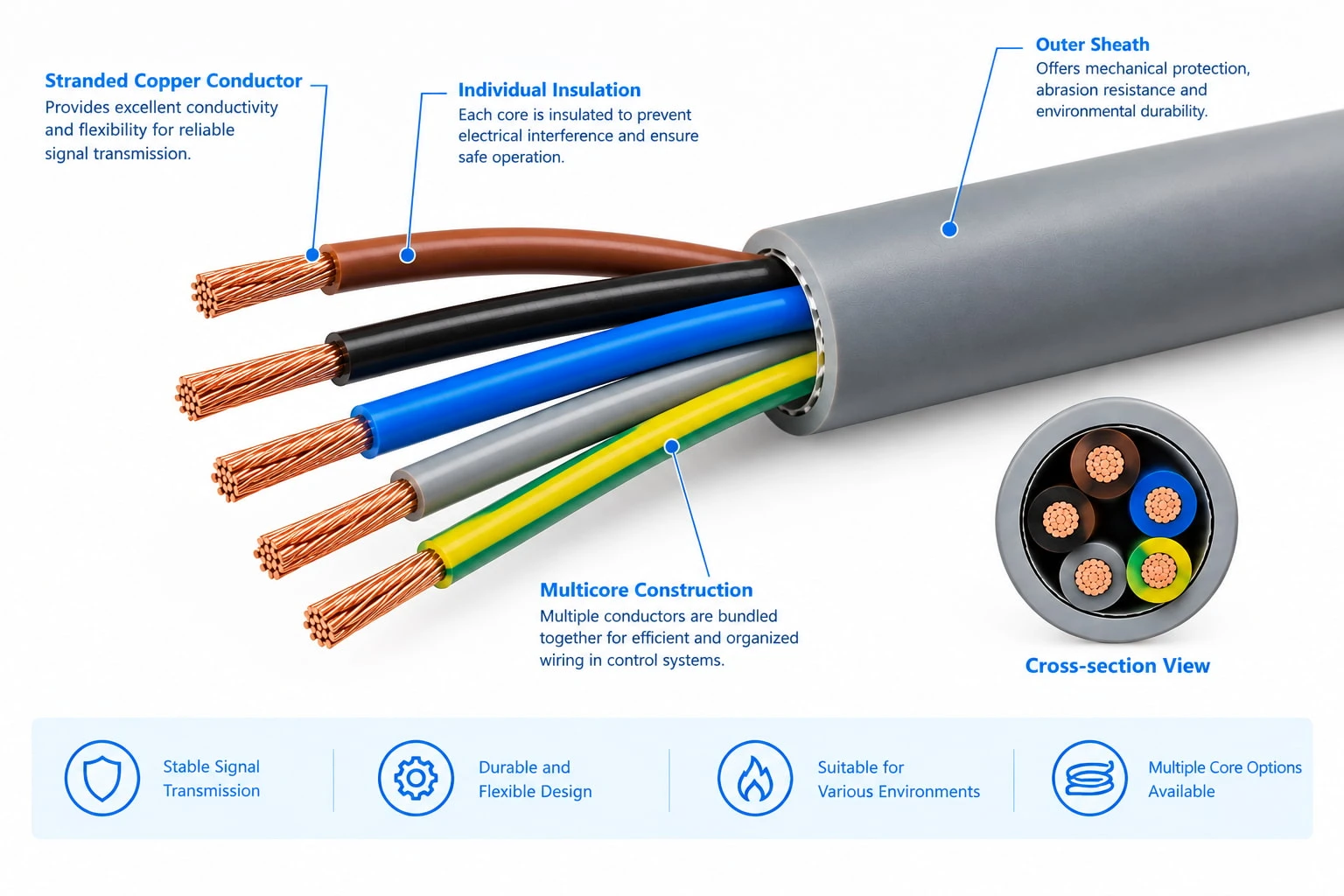
What Is Electrical Control Cable?
Electrical control cable is a broad product description for cables used in electrical control, monitoring, interconnection and related equipment circuits. Depending on the design, a cable may contain multiple insulated conductors that carry switching commands, status signals, interlock circuits or other defined electrical connections.
In a typical industrial installation, a control cabinet contains devices such as relays, terminal blocks and programmable logic controllers (PLCs). Field equipment may include limit switches, sensors, actuators, valves and machine components. Control cables connect these devices according to the electrical schematic, allowing the system to respond to operating conditions and commands.
The term electrical control cable does not define one universal construction. Core count, conductor size, insulation material, rated voltage, screening, armouring and outer sheath requirements must be specified separately. The same product name may be used for cables with significantly different capabilities, so buyers should evaluate the actual technical specification rather than relying on the name alone.
How Electrical Control Cable Works in an Industrial System
A control cable provides the electrical path between the devices identified in a circuit design. Its role depends on the control architecture and the type of equipment connected at each end.
Control cabinet to machine connections
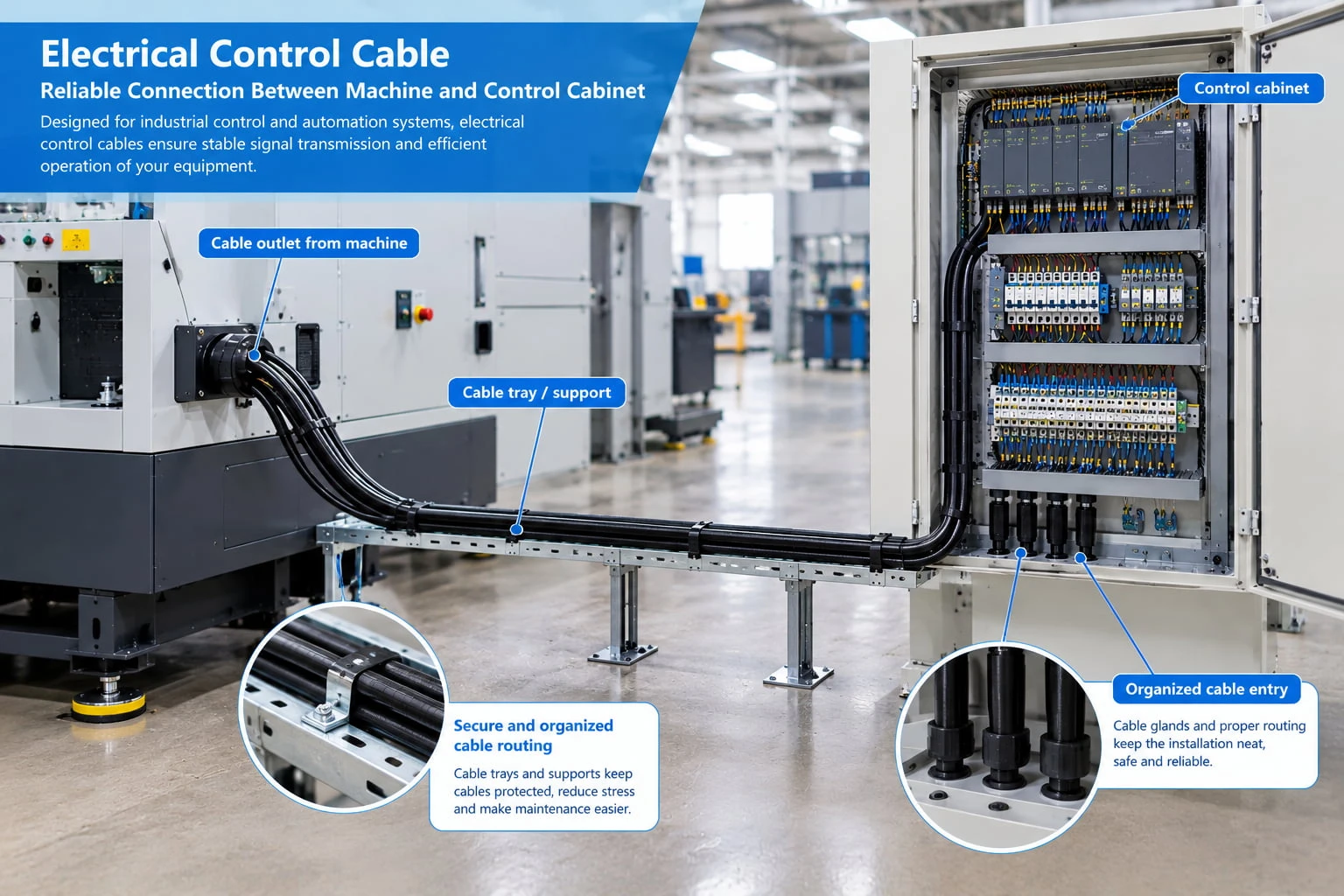
A machine control cabinet may need connections to motor contactors, position switches, safety-related devices, status indicators and other field components. Where the wiring design permits, a multicore cable can group several control conductors into one cable assembly. Each conductor is assigned to a circuit and terminated according to the approved wiring diagram.
The practical benefit is an organized cable route and a defined conductor arrangement. Correct core identification, suitable cable entry hardware and adequate mechanical support remain essential. A cable with the right core count can still be unsuitable if its voltage rating, conductor size or installation characteristics do not match the circuit.
Sensor and status-signal wiring
Industrial sensors can provide switching outputs, analog signals or other forms of feedback. The required cable depends on the sensor interface, output characteristics, cable length and electrical environment. Some simple switching circuits can use a general control cable, while sensitive analog signals or communication interfaces may require a more specific cable construction.
Where a signal is vulnerable to electromagnetic interference, cable routing, separation from power conductors, screening and termination should be assessed together. Adding a shield without considering the complete installation does not guarantee reliable signal transmission.
Interlocks and auxiliary control circuits
Interlock and auxiliary circuits help coordinate equipment operation. Their cable requirements depend on the circuit voltage, current, control philosophy and applicable safety design. Where a circuit forms part of a safety-related system, the cable and installation must comply with the system's documented requirements; a general-purpose control cable should not be assumed to satisfy a particular safety function automatically.
Electrical Control Cable Construction
A cable's construction determines how its electrical and mechanical requirements are addressed. The following components are common design considerations, but the exact layers and materials must be confirmed for the selected Huawang Cable product.
| Component | Function | What to Verify |
|---|---|---|
| Copper conductor | Carries the specified control current or electrical signal. | Conductor material, cross-sectional area, stranding, conductor class and resistance requirements. |
| Core insulation | Electrically separates each conductor from other conductors and surrounding layers. | Insulation compound, thickness, voltage rating and temperature requirements. |
| Core identification | Helps installers distinguish individual circuits during termination and maintenance. | Colour coding, numbering and consistency with the wiring diagram. |
| Core assembly | Groups the insulated conductors into one cable. | Core count, arrangement, fillers or wrapping where applicable, and finished dimensions. |
| Metallic screen, if required | Helps manage electromagnetic interference in compatible applications. | Screen material, construction, coverage requirements and termination method. |
| Inner sheath or protective layer, if required | Provides separation or support within certain cable constructions. | Layer arrangement, material compatibility and applicable construction standard. |
| Armour, if required | Provides additional mechanical protection in designs intended for that purpose. | Armour type, installation method, mechanical risks and applicable standard. |
| Outer sheath | Provides the external protective layer for the intended environment. | Material, temperature range, abrasion, oil, UV, moisture and fire-performance requirements. |
Conductor size should match the circuit
The conductor cross-sectional area affects electrical resistance, voltage drop, current-carrying capability and termination compatibility. Its selection should reflect the actual circuit design, cable length, installation conditions and applicable regulations.
Control circuits do not all have the same electrical requirements. A circuit carrying a switching load may need a different conductor size from one carrying a low-level signal. Where the cable serves several circuits, the designer must consider the requirements of the conductors and the complete cable construction.
Choosing a larger conductor without a technical reason may increase cost and outside diameter. Choosing one that is too small may cause excessive voltage drop or fail to meet the circuit requirements. Buyers should provide the required conductor size or the information needed for engineering review instead of assuming that one size suits every application.
Insulation and sheath selection
Core insulation and the outer sheath serve different purposes. The insulation separates conductors electrically, while the sheath protects the assembled cable against environmental and mechanical exposure within the limits of its design.
PVC, XLPE, LSZH and other material systems may be used in different cable designs. However, material names alone do not establish a complete performance rating. Operating temperature, flame behavior, smoke emission, oil resistance, UV resistance and chemical compatibility must be confirmed from the relevant product documentation and test requirements.
How to Choose the Right Electrical Control Cable
For procurement, the most useful starting point is the circuit schematic and installation plan. A clear specification helps distinguish a general-purpose control cable from a product requiring a particular core arrangement, shielding construction or mechanical protection.
1. Identify the circuit function
Determine whether the cable will carry switching commands, sensor signals, status feedback, auxiliary control power or a combination of defined functions. If the cable will connect a specialized communication interface or sensitive instrument, verify whether that system requires a dedicated cable type.
2. Confirm the core count and conductor size
Use the wiring diagram to establish how many conductors are required and whether spare cores are justified. Confirm the cross-sectional area or AWG size, conductor construction and any specific resistance requirements. Core count alone does not define electrical capacity or application suitability.
3. Check the voltage and operating conditions
The selected cable's declared voltage rating must be appropriate for the circuit and installation. Temperature, cable length, installation method and environmental exposure can also affect the choice. Use the approved datasheet for numerical limits rather than assuming that all industrial control cables share the same ratings.
4. Decide whether screening is necessary
Consider the potential for electromagnetic interference, the sensitivity of the connected circuit and the equipment manufacturer's instructions. Screening may be appropriate for certain installations, but the final arrangement must also address routing, grounding and screen termination.
5. Assess mechanical protection
A cable installed inside a protected enclosure has different mechanical demands from one routed through a plant area where impact, abrasion or compression may be possible. Depending on the risks, the design may need a suitable sheath, protective conduit, cable tray or armoured construction.
6. Confirm the applicable standard and documentation
Project requirements may specify product standards, conductor requirements, flame classifications or other compliance documentation. These requirements should be identified before quotation and confirmed against the exact product offered. Do not assume that a generic product description proves compliance with a particular standard.
Which Electrical Control Cable Is Suitable for Your Application?
Electrical control cable is a broad category. The following related product types address different design priorities and should not be treated as interchangeable without checking their specifications.
| Product Type | When to Consider It | Key Confirmation |
|---|---|---|
| PVC Control Cable | General control circuits where the specified PVC construction meets the installation requirements. | Rated voltage, core configuration, temperature and environmental suitability. |
| Multicore Control Cable | Applications that require multiple insulated conductors grouped into one cable assembly. | Core count, conductor size, core identification and cable dimensions. |
| Shielded Control Cable | Control or signal circuits where screening is required by the electrical environment or system specification. | Screen construction, grounding, termination and routing. |
| Flexible Control Cable | Installations requiring greater routing flexibility or movement within the cable's rated limits. | Movement type, bending radius, travel conditions and service requirements. |
| Steel Tape Armoured Cable | Applications where the specified armoured construction is appropriate for mechanical protection. | Armour design, installation method and mechanical protection requirements. |
| Low Smoke Zero Halogen Control Cable | Projects that specify low-smoke and halogen-free cable materials for particular locations. | Required material properties, test classification and project compliance criteria. |
The product links above lead to related Huawang Cable pages. The final selection should be made from the actual technical data for each product, rather than from the category name alone.
Applications Across Different Industries
Industrial automation and production machinery
Production lines use control wiring to connect sensors, actuators, interlocks, control cabinets and machine components. A suitable cable arrangement can simplify routing between the field devices and control system, but the cable must still match the number of circuits, installation conditions and equipment requirements.
Where control cables run close to motors or variable-speed drives, electromagnetic compatibility should be assessed. In moving machine sections, the selection must also account for repeated bending and mechanical stress. These requirements can lead to different cable choices within the same production facility.
Conveyor and material-handling equipment
Conveyor systems may require connections for position switches, product detection, alarms and equipment status. The appropriate core configuration depends on the control scheme and the number of field connections. Routing, support, abrasion and access for maintenance should be considered during installation planning.
If the cable passes through moving sections, a fixed-installation cable should not be assumed suitable for continuous movement. The required mechanical performance must be verified against the manufacturer's specification.
Instrumentation and process equipment
Process systems may use control cables for discrete signals, auxiliary circuits and equipment status. However, some measurement circuits require specific electrical characteristics or individually screened pairs. A general electrical control cable should not automatically be substituted for an instrumentation cable when the instrument documentation defines a particular construction.
For installations near electrical noise sources, review the complete signal path, including cable routing, screen termination and the connected equipment. Reliable signal performance depends on the system design as well as the cable.
Power generation and electrical infrastructure
Power stations, substations and related infrastructure may use control wiring for monitoring, switching, indication and auxiliary systems. These installations can have detailed requirements for electrical ratings, flame performance, mechanical protection and documented compliance.
The cable must be selected according to the specific circuit and project standard. If a system requires a particular fire-performance classification or continued circuit operation under defined fire conditions, the required test standard and product construction must be verified explicitly.
Building services and commercial facilities
Pumps, ventilation systems, building equipment and other electrical services may rely on control wiring for commands, status feedback and interlocks. The selection depends on the equipment design, cable route, fire-safety requirements and environmental exposure.
For installations in occupied buildings, the project may specify particular smoke or halogen requirements. Such requirements should be treated as explicit compliance criteria, not inferred from the general label "control cable."
Installation Details That Affect Cable Performance
Even a correctly specified cable can be damaged or perform poorly if the installation does not follow its limits. Installation planning should consider the cable route, supports, bend radius, pulling forces, environmental exposure and termination method.
- Bending radius: Follow the value specified for the actual cable construction and installation method. Do not apply a generic bending-radius multiplier to every cable.
- Pulling and support: Avoid excessive pulling tension, crushing forces and unsupported cable weight.
- Cable entry: Confirm that glands, connectors and enclosure openings suit the actual cable diameter and construction.
- Environmental exposure: Review heat, moisture, oil, chemicals, sunlight and abrasion where applicable.
- Core identification: Match conductor identification to the wiring diagram and terminal schedule.
- Screen termination: For screened cables, follow the system's grounding and termination requirements.
- Separation from power circuits: Follow project rules and system guidance where separation is required to manage interference or satisfy electrical safety requirements.
Manufacturing and Quality Control Considerations
For an industrial cable order, quality should be evaluated against an agreed technical specification rather than general statements about reliability. The required conductor construction, insulation, core identification, cable dimensions and sheath material should be defined before production approval.
Conductor and insulation consistency
The conductor material, cross-sectional area and construction should correspond to the approved design. Insulation material and dimensions must also meet the relevant specification. Depending on the product and applicable standard, required verification may include conductor resistance, insulation-related electrical tests and dimensional inspection.
Core assembly, marking and finished cable
Core count, identification and assembly should match the approved construction. Outer sheath marking can help identify the product and its intended specification, provided the marking requirements have been agreed. The finished cable should be checked against the order details and relevant acceptance criteria.
Technical documents and traceability
Buyers may require a product datasheet, dimensional information, test records, compliance documentation or batch identification. The specific documents depend on the project and product standard. Any certification or test claim should be supported by documentation that applies to the supplied construction.
Huawang Cable's available manufacturing options, inspection procedures, testing capabilities and certifications should be confirmed using current factory records and the relevant product datasheet. For customized orders, the buyer and manufacturer should agree on the technical specification before production, including any special marking, packaging or inspection requirements.
Information to Include in a Request for Quotation
A precise request for quotation (RFQ) helps the manufacturer evaluate the required cable without guessing about important electrical or installation details.
| RFQ Item | Details to Provide |
|---|---|
| Application | Machine, control cabinet, instrumentation, building equipment or another defined use. |
| Core configuration | Required core count, conductor allocation and any spare-core requirements. |
| Conductor | Material, cross-sectional area or AWG size, and conductor class where specified. |
| Electrical rating | Rated voltage and other electrical characteristics required by the circuit. |
| Insulation and sheath | Required materials, temperature limits and environmental properties. |
| Screening or armour | Whether shielding or additional mechanical protection is required, and the specified construction. |
| Installation method | Fixed or moving installation, indoor or outdoor route, tray, conduit or other installation details. |
| Standards and approvals | Applicable standards, fire classifications and documentation required for project acceptance. |
| Quantity and packaging | Total quantity, cable length, reel or drum requirements, marking and destination. |
Where available, include the wiring diagram, equipment manual, existing cable specification or project data sheet. These references can help clarify the electrical function and reduce the risk of selecting a cable that has the correct general name but the wrong construction.
Frequently Asked Questions About Electrical Control Cable
What is electrical control cable used for?
Electrical control cable is used to connect devices in control, monitoring, switching and equipment-interconnection circuits. Typical applications include industrial machinery, control cabinets, automation equipment and building services. The required construction depends on the circuit and installation environment.
Is electrical control cable the same as power cable?
No, not necessarily. Power cables are generally selected to supply electrical energy to equipment or distribution systems, while control cables are generally used for commands, status signals and related circuits. Some applications may involve overlapping electrical functions, so the intended use and rated specifications must be confirmed.
Does electrical control cable always have multiple cores?
No. The term is broad and does not by itself define a particular core count. The number of conductors must be specified according to the circuit design. For applications requiring multiple conductors in one cable assembly, a multicore control cable may be appropriate.
Should I choose a shielded electrical control cable?
Choose a shielded construction when the system specification or electromagnetic environment requires it. The decision depends on the signal characteristics, nearby electrical equipment, routing and termination design. A shielded cable does not eliminate the need for correct installation practices.
Can electrical control cable be used for moving equipment?
Only when the selected cable is suitable for the intended movement. Repeated bending, torsion and continuous cable-carrier operation impose different demands from fixed installation. Confirm the required movement rating, bending limits and environmental conditions with the manufacturer.
What sheath material should I choose?
The choice depends on the installation environment and project requirements. Consider temperature, abrasion, oil, moisture, UV exposure and any flame, smoke or halogen requirements. The material name alone is not enough to establish suitability; the product's documented performance must be checked.
Which specifications are needed to order electrical control cable?
Provide the application, core count, conductor size, rated voltage, insulation and sheath requirements, screening or armour needs, installation method, applicable standards, quantity and cable length. A wiring diagram or existing datasheet can help the supplier confirm the correct construction.
Choosing Electrical Control Cable for Your Project
The right electrical control cable is defined by the work it must perform, not by a broad product name. Circuit function, conductor configuration, electrical rating, installation conditions and applicable standards should all be considered before the cable is approved.
For industrial procurement, a complete specification and the correct supporting documentation are the most effective starting points. Confirm the final cable construction against the manufacturer's technical data before production or installation, especially where the project requires screening, additional mechanical protection, special environmental performance or documented compliance.
Hot Tags: electrical control cable manufacturer, electrical control cable supplier, industrial electrical control cable, electrical control wiring cable, multicore electrical control cable, electrical control cable specifications, 12 core control cable, cable control, control cable, electrical control cable, power wiring and control wiring, PVC Control Cable