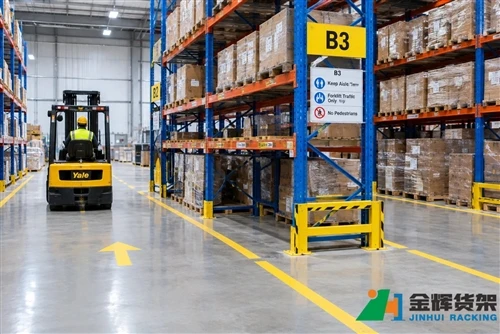
Pallet rack end-of-aisle areas are important transition points in a warehouse. Forklifts often turn, enter or leave rack aisles, move between storage blocks, and travel toward staging or shipping areas through these locations.
When an aisle end is poorly organized, pallets, carts, equipment, or temporary inventory can quickly interfere with forklift movement and visibility. A clear and well-managed end-of-aisle area helps keep warehouse traffic predictable while maintaining access to pallet rack locations.
What Is a Pallet Rack End-of-Aisle Area?
A pallet rack end-of-aisle area is the space located at the end of a rack row where the storage aisle connects with another aisle, traffic route, staging area, or open warehouse space.
Unlike the storage positions inside a rack aisle, the aisle end is primarily a movement and transition area. Forklifts may use it to turn, change direction, enter another aisle, or move pallets between different warehouse zones.
For this reason, the area should not automatically be treated as additional storage space simply because there is unused floor area.
Why Do Rack End-of-Aisle Areas Matter?
A rack aisle end can influence how smoothly forklifts and other warehouse equipment move around the storage system.
A poorly managed aisle end can create several operational problems:
- Temporary pallets may obstruct forklift movement.
- Stored materials may reduce visibility around turns.
- Forklifts may need to make unnecessary reversing movements.
- Pedestrian and forklift traffic may intersect unexpectedly.
- Equipment may accumulate around high-traffic areas.
- Operators may use the area as informal staging space.
Keeping these transition areas organized can therefore support better traffic flow without changing the entire pallet rack layout.
What Should Be Kept Clear at Rack Aisle Ends?
The exact clearance requirements depend on the warehouse layout, material-handling equipment, rack configuration, and applicable regulations. However, the basic principle is straightforward: areas needed for vehicle movement and required access should remain free from unauthorized storage.
Items that should not be allowed to gradually accumulate around aisle ends include:
- Loose pallets
- Temporary inventory
- Packaging materials
- Waste containers
- Unused warehouse equipment
- Hand carts and pallet trucks
- Damaged pallets awaiting disposal
- Other materials that restrict normal traffic
If an aisle end repeatedly becomes a temporary storage location, the warehouse should review whether the existing staging areas are sufficient for actual operating demand.
How Should Forklifts Approach Rack Aisle Ends?
Forklift movement at aisle ends should be predictable. Operators need enough space and visibility to enter, leave, or turn without unexpected obstructions.
Warehouse procedures should consider:
- Forklift type and turning characteristics
- Typical pallet and load dimensions
- Traffic direction
- Visibility around rack corners
- Pedestrian movement
- Nearby staging areas
- Other equipment operating in the same zone
Forklift operators should follow the site's established traffic rules rather than treating the open area at the end of a rack row as unrestricted space.
How to Prevent Pallets from Blocking Aisle Ends
Temporary pallet storage is one of the most common causes of disorder around rack aisle ends.
Receiving, picking, replenishment, and shipping activities can all generate pallets that need to be moved again. If employees do not have a clearly defined staging location, these pallets may gradually migrate toward the nearest open area.
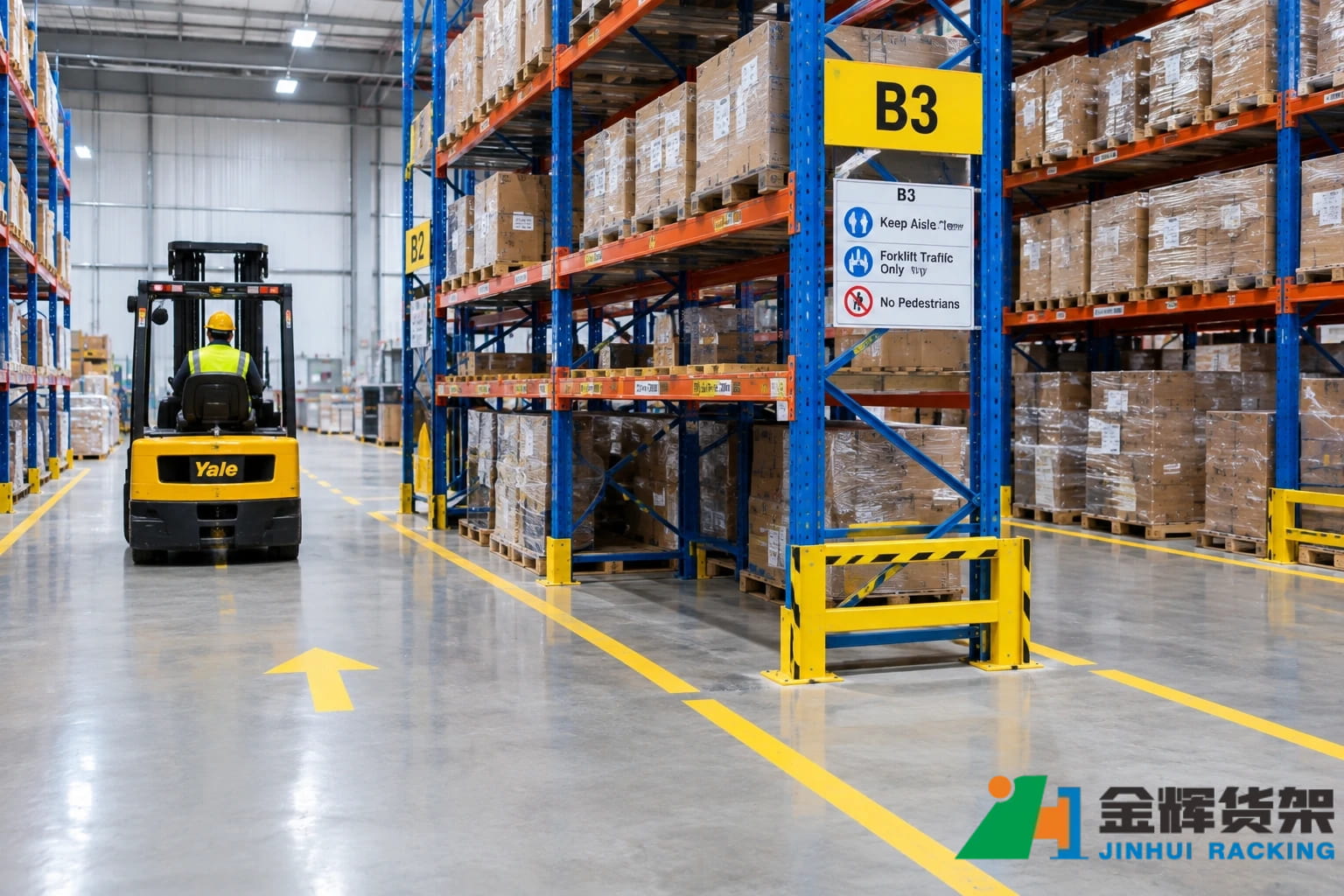
A simple control process can help prevent this:
- Define approved staging locations.
- Mark areas that must remain clear for traffic.
- Do not use rack aisle ends as general-purpose storage.
- Move temporary pallets to their designated locations promptly.
- Review recurring overflow during peak operating periods.
The objective is not to eliminate temporary pallet staging, but to prevent it from interfering with the movement network around the rack system.
How Visibility Affects Rack Aisle Ends
Visibility is especially important where forklifts turn or cross paths with other vehicles and pedestrians.
Rack structures, stacked products, temporary pallets, columns, equipment, and other obstacles can restrict an operator's view of the surrounding area.
When reviewing an aisle end, consider whether operators can see:
- Approaching forklifts
- Pedestrians
- Crossing traffic
- Temporary staging activity
- Other warehouse equipment
If visibility is restricted, the warehouse should evaluate its traffic controls and operating procedures rather than simply assuming that the aisle end is safe because there is enough floor area.
How Pedestrian Traffic Should Be Managed Near Rack Aisle Ends
Rack aisle ends can also become natural crossing points for warehouse employees walking between storage, picking, receiving, and shipping areas.
Where forklift and pedestrian routes intersect, the warehouse should establish clear traffic controls appropriate for the site.
Depending on the facility, this may include:
- Clearly marked pedestrian walkways
- Designated crossing points
- Floor markings
- Traffic signs
- Physical separation where appropriate
- Site-specific forklift and pedestrian procedures
The goal is to make movement patterns predictable rather than allowing people and vehicles to choose informal routes through rack end areas.
How to Manage Staging Near Rack Aisle Ends
Some warehouses need temporary staging close to storage areas. This can be practical, but the staging zone should be deliberately positioned rather than created whenever an open space becomes available.
| Area | Primary Purpose | Management Approach |
|---|---|---|
| Rack aisle | Access to pallet positions | Keep storage access and forklift movement clear |
| Rack aisle end | Traffic transition and turning | Prevent unauthorized storage and obstructions |
| Staging zone | Temporary pallet holding | Define capacity and storage duration |
| Cross aisle | Movement between rack blocks | Maintain clear traffic flow |
| Shipping area | Outbound preparation | Keep staging within designated boundaries |
If temporary inventory consistently exceeds the available staging space, the warehouse should review receiving and shipping processes rather than allowing aisle ends to become overflow storage.
How Rack Row Length Can Affect Aisle End Traffic
The longer a rack row becomes, the more dependent forklift operators may be on the aisle ends for entering, leaving, or changing routes.
Long rack rows can therefore concentrate traffic at specific end locations. If several rack rows connect to the same traffic route, the resulting intersection may become a busy operating point.
Rack row length should be considered together with cross aisles, forklift routes, building columns, staging areas, and warehouse throughput.
For larger storage projects, warehouse pallet rack solutions can be configured around the actual warehouse dimensions and material-flow requirements rather than treating each rack row as an isolated storage unit.
How to Organize Equipment Around Rack Aisle Ends
Forklifts are not the only equipment that can create problems around aisle ends. Pallet trucks, carts, ladders, cleaning equipment, waste containers, and charging equipment can also gradually occupy these areas.
Each item should have a defined storage location when it is not being used.
A useful rule is to ask a simple question whenever equipment is left at an aisle end: Is this item supposed to be here?
If the answer is no, it should be moved to its designated location rather than becoming a permanent obstruction.
How Rack End Areas Affect Warehouse Traffic Flow
Aisle ends are connected to the larger warehouse traffic network. A problem at one rack end can therefore affect several surrounding areas.
For example, if a pallet blocks one aisle end, forklifts may need to reverse or take another route. If several aisle ends experience the same problem, travel distances can increase and traffic may become concentrated in other areas.
For this reason, aisle-end organization should be considered together with the overall warehouse traffic plan.
Our guide on reducing warehouse congestion around pallet racking provides additional guidance on traffic routes, staging areas, cross aisles, and forklift movement.
Common Rack Aisle End Management Mistakes
Using Aisle Ends as Permanent Storage
An open area at the end of a rack row can look convenient for temporary storage. However, repeated use can restrict traffic and make the area increasingly difficult to control.
Allowing Damaged Pallets to Accumulate
Damaged pallets waiting for repair or disposal should have a designated holding location. Leaving them around rack ends creates unnecessary obstacles.
Ignoring Peak Traffic Periods
An aisle end may appear clear during quiet periods but become congested during receiving, picking, or shipping peaks. Traffic management should account for the busiest operating conditions.
Placing Equipment Where It Is Convenient
Equipment that is frequently left near an aisle end can gradually become part of the traffic problem. Defined equipment storage locations help maintain clear operating areas.
Creating Informal Pedestrian Crossings
Employees may naturally choose the shortest route through a rack end. If this creates repeated interaction with forklift traffic, the warehouse should review the pedestrian route and establish clearer controls.
How to Mark and Manage Rack Aisle Ends
Floor markings and signs can help communicate how an aisle end should be used.
Depending on the warehouse layout, markings can identify:
- Forklift travel routes
- No-storage areas
- Pedestrian crossings
- Temporary staging positions
- Rack row identification
- Emergency access areas
Markings are most effective when they reflect the actual operating procedure. If employees routinely need to place pallets in an area marked as no-storage, the warehouse should review the process rather than repeatedly repainting the floor.
When Should a Rack Aisle End Be Replanned?
A rack aisle end may need a layout review when the warehouse's operating conditions have changed significantly.
Common reasons include:
- More forklifts are operating in the area.
- Warehouse throughput has increased.
- New pallet dimensions are being introduced.
- Receiving or shipping volumes have changed.
- New staging requirements have appeared.
- Pedestrian routes have changed.
- New equipment has been introduced.
- Repeated congestion occurs at the same aisle end.
In these situations, review the entire traffic pattern instead of changing only one rack end in isolation.
Rack Aisle End Organization Checklist
| Check | Question |
|---|---|
| Traffic | Can forklifts enter and leave the aisle without unnecessary obstruction? |
| Storage | Are temporary pallets kept in designated staging areas? |
| Visibility | Are operators able to see relevant traffic around the aisle end? |
| Pedestrians | Are pedestrian routes clearly defined where they interact with forklift traffic? |
| Equipment | Are carts, pallet trucks, and other equipment stored away from traffic routes? |
| Markings | Are floor markings and signs consistent with actual warehouse procedures? |
| Peak Operations | Does the aisle end remain functional during the busiest periods? |
FAQ About Pallet Rack End-of-Aisle Areas
Can pallets be stored at the end of a pallet rack aisle?
Only when the area is specifically designed and designated for that purpose and the storage does not interfere with required traffic or access. A rack aisle end should not automatically be treated as general storage space.
Why do rack aisle ends become congested?
Common causes include temporary pallet staging, high forklift traffic, insufficient staging space, pedestrian movement, equipment storage, and poorly coordinated traffic routes.
How can I keep a rack aisle end clear?
Define the area's purpose, mark no-storage zones where appropriate, provide adequate staging space, assign equipment storage locations, and regularly remove materials that do not belong there.
Should rack aisle ends have floor markings?
Floor markings can help communicate traffic routes, staging boundaries, pedestrian crossings, and no-storage areas. The markings should match the actual warehouse operating procedures.
Do rack aisle ends need special protection?
Protection requirements depend on the warehouse layout, forklift traffic, rack configuration, and applicable safety requirements. High-traffic rack ends should be evaluated as part of the overall rack protection plan.
Final Thoughts
Pallet rack end-of-aisle areas are more than unused floor space. They are important transition points where storage traffic, forklifts, pedestrians, staging activities, and other warehouse movements can interact.
Keeping these areas organized starts with a clear definition of their purpose. Temporary pallets should have designated staging locations, equipment should have assigned storage areas, and traffic routes should remain predictable and unobstructed.
For warehouses experiencing repeated congestion around rack aisle ends, the solution may involve changes to staging, traffic direction, rack layout, or material flow rather than simply adding more floor markings.
If you are planning a pallet racking project or reviewing an existing warehouse layout, Jinhui Rack can help evaluate rack configuration, aisle arrangement, forklift access, storage requirements, and overall warehouse flow.
WhatsApp: +86 185 0252 7163
Email: info@jhrack.com
Website: https://www.jinhui-rack.com/