An access control system can only work as intended when its readers, controllers, door sensors, and locking devices are connected with suitable wiring. A card reader may identify an authorized user in a fraction of a second, but the system still depends on dependable data connections, correctly sized power conductors, and properly installed door-status and lock circuits.
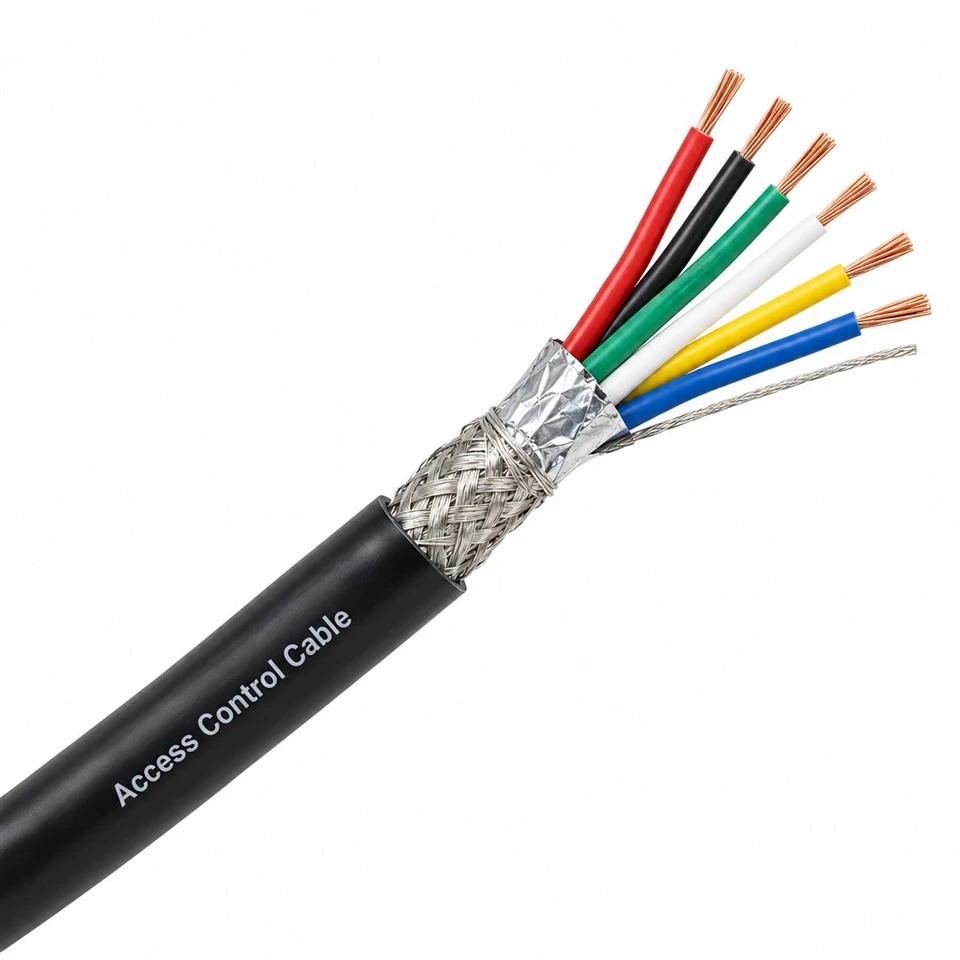
Access control cable is a broad term for cables used to connect these components in electronic access control installations. Depending on the system design, the wiring may carry reader data, low-voltage power, door-position signals, request-to-exit signals, or connections to other security equipment. Some installations use separate cables for different functions; others use multicore constructions where the system design permits.
For security integrators, contractors, and equipment buyers, the important question is not simply how many cores a cable contains. It is whether the cable matches the connected devices, transmission method, power requirements, installation route, and applicable building or fire-safety rules.
What Is Access Control Cable?
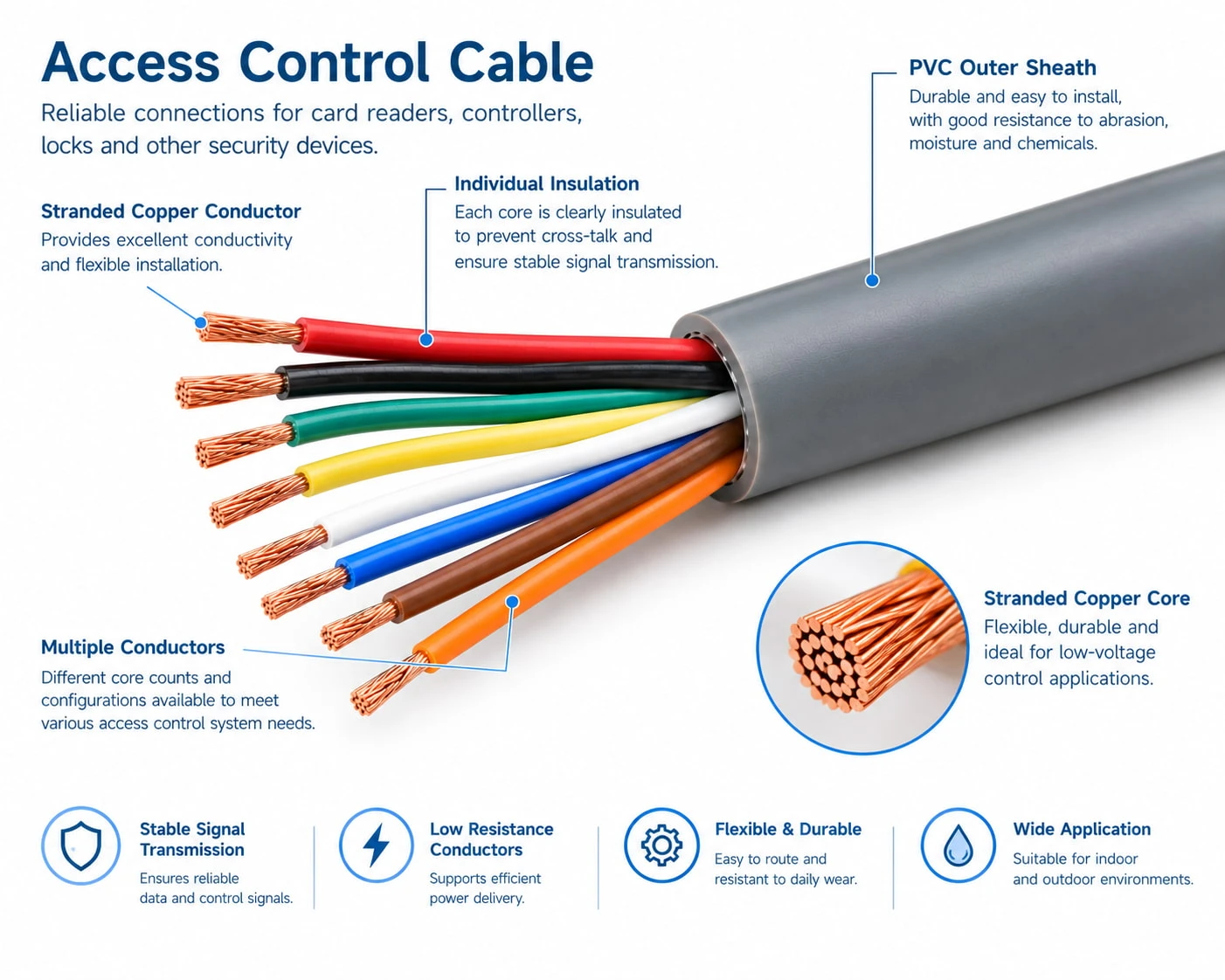
Access control cable is used to establish electrical connections between the components that manage entry to a building, room, restricted area, or secured facility. These systems may include card readers, keypads, biometric readers, access controllers, electric strikes, electromagnetic locks, door contacts, and exit buttons.
There is no single construction that suits every access control system. A reader interface may require a specific data-pair arrangement, while a lock circuit may need conductors sized for its operating current. A door contact may require only a simple low-current circuit. Treating these connections as interchangeable can result in unnecessary wiring complexity or an unsuitable cable specification.
Before choosing a cable, identify the equipment at both ends of each connection and consult the wiring diagrams supplied by the equipment manufacturer. These documents determine which circuits need to be connected and help establish the cable requirements.
Which Access Control Connections Need Cable?
A typical controlled door contains several electrical connections. Understanding their different functions is the starting point for specifying the cable correctly.
| System Component | Connection Function | Key Cable Consideration |
|---|---|---|
| Card reader or keypad | Transfers reader data and, where required, power. | Confirm the reader interface, conductor arrangement, power requirements, and any shielding recommendation. |
| Access controller | Processes reader inputs and controls door-related outputs. | Match the cable to the controller terminals and the selected communication interface. |
| Electric strike or electromagnetic lock | Supplies power to the locking device. | Check operating current, voltage drop, cable length, and the lock manufacturer's requirements. |
| Door position contact | Reports whether the door is open or closed. | Confirm the contact circuit, required conductor count, and routing conditions. |
| Request-to-exit button or sensor | Sends an exit request to the control system. | Verify the switching arrangement and whether additional conductors are required. |
| Network-connected controller | Connects the controller to a communications network. | Use cable specifically suitable for the network interface and required transmission performance. |
These functions do not necessarily require one combined cable. The equipment manufacturer's instructions and the project wiring design should determine whether separate cables or an approved multicore construction is appropriate.
Choosing the Right Access Control Cable Construction
Conductor Material and Size
Copper conductors are commonly used in low-voltage control and security wiring because of their electrical conductivity and established termination practices. However, the correct conductor size depends on what the cable is carrying.
For an electric lock, conductor resistance can cause voltage drop between the power supply and the device. This matters when a lock is located a considerable distance from the controller or power source. A cable that works on a short bench test may not deliver the required voltage at the device when installed across a long building route.
Reader data circuits have different considerations. The required conductor arrangement, cable characteristics, and permissible distance depend on the interface and equipment specification. Do not choose a cable solely because its copper conductors are large enough for the power load; the complete construction must also suit the data connection.
Number of Cores and Pair Configuration
Core count should follow the wiring diagram, not a general assumption about how many wires a door needs. Some reader interfaces use a small number of conductors, while others require additional connections for power, data, status, or control functions. The exact arrangement depends on the reader technology and system architecture.
Where a data interface specifies twisted pairs, the pair arrangement must be maintained as required by the equipment and cable specification. A multicore cable is not automatically a substitute for a cable designed for a particular data interface.
For installations with multiple door devices, create a cable schedule that records the source, destination, circuit function, conductor size, and cable type for each run. This makes purchasing more accurate and helps installers identify connections during commissioning and future maintenance.
Shielding and Electrical Interference
Access control wiring may pass through areas containing power cables, motors, fluorescent or switching equipment, and other potential sources of electrical interference. Whether shielding is necessary depends on the signal type, route, equipment instructions, and installation environment.
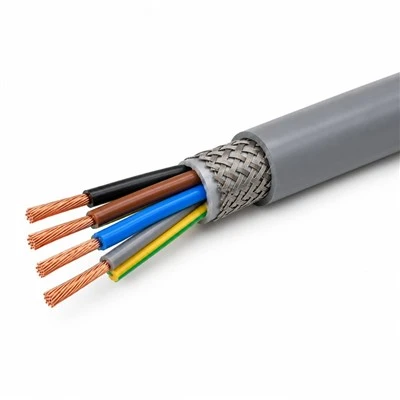
A shielded construction may be appropriate for certain sensitive signal circuits, but shielding is not a universal requirement for every reader, lock, or door contact. The shield's termination and grounding method also matter. An incorrectly installed shield may fail to provide the expected benefit.
Where a shielded construction is required, compare the proposed design with Huawang Cable's Shielded Control Cable range. Confirm that the particular cable meets the access system's electrical and transmission requirements before substituting it for a specified security or data cable.
Insulation and Outer Sheath
The cable jacket should suit the route through which it will be installed. Wiring concealed in a protected indoor route faces different conditions from wiring exposed to sunlight, moisture, abrasion, or mechanical damage.
Material selection should account for the installation environment and the ratings declared for the actual cable. A PVC sheath may suit some general-purpose indoor applications, while other projects may specify different compounds or additional performance requirements. The material name alone does not establish outdoor suitability, fire performance, or chemical resistance.
For projects with defined smoke and halogen requirements, review the specifications of Low Smoke Zero Halogen Control Cable. Confirm the relevant test standards and required performance rather than assuming a general control cable meets the building specification.
How to Calculate Cable Requirements for Door Locks
Electric locks deserve particular attention because the cable carries operating current as well as connecting the device to the control system. If the voltage reaching the lock falls below the device's acceptable operating range, the lock may not operate reliably.
A practical selection process is to:
- Obtain the lock's rated voltage and operating current from its datasheet.
- Measure the cable route and determine the electrical circuit length using the appropriate calculation method.
- Calculate expected voltage drop using the conductor resistance and circuit arrangement.
- Check the result against the lock manufacturer's permitted voltage range.
- Account for the installation method, temperature, grouping, connections, and applicable electrical requirements.
For a simple DC circuit, voltage drop can be estimated using the circuit current and the total resistance of the outgoing and return conductors:
Voltage drop = circuit current × total circuit resistance
This is a simplified relationship, not a complete cable-sizing standard. Use the appropriate engineering method and verified conductor resistance for the actual cable. For devices with inrush current or other non-steady operating conditions, also review the manufacturer's guidance.
Access Control Cable Installation: Details That Matter
Many wiring problems arise from installation decisions rather than from the cable name itself. A cable can meet its basic electrical specification yet perform poorly if it is damaged during pulling, routed inappropriately, or terminated incorrectly.
Plan the Route Before Pulling Cable
Confirm the route from the controller to each device, including concealed sections, door frames, cable trays, conduits, and transitions between fixed and moving parts. Check the permitted bend radius and pulling requirements for the chosen cable.
Where access control wiring shares a route with power wiring, follow applicable separation requirements and the equipment manufacturer's instructions. Do not assume that placing different circuits in the same tray or conduit is permitted in every installation.
Protect Wiring at Doors and Moving Sections
Door leaves, hinges, and moving hardware can expose cables to repeated bending, pinching, and abrasion. A cable suitable for a stationary wall route may not be suitable for repeated movement at a door transfer point. Select an appropriate cable and protective arrangement for the actual movement and mechanical conditions.
Keep the transition between fixed and moving sections properly supported, and avoid bends or pulling forces that exceed the cable manufacturer's limits. Inspect the route for sharp edges and potential crushing points before commissioning.
Label and Test Each Circuit
Identify cable ends and conductors consistently with the project drawings. Labels should make it possible to trace a reader, lock, or contact circuit without relying on memory or wire color alone.
Before connecting equipment, carry out the checks required by the project and equipment manufacturers. These may include conductor continuity, correct terminal assignment, insulation checks where applicable, power-supply verification, and functional testing of each door device. Record any required test results in the project documentation.
Access Control Cable Applications
Commercial Offices and Multi-Tenant Buildings
Office buildings may have controlled entrances, internal restricted areas, meeting rooms, server rooms, and access-controlled lifts or service spaces. Cable planning should account for the number of controlled doors, the location of control panels, future expansion, and the building's wiring routes.
Warehouses and Industrial Facilities
Warehouses and industrial sites may include pedestrian entrances, staff-only areas, equipment rooms, and perimeter access points. Routes can be longer or more exposed than those in a small office. Cable protection, voltage drop, environmental ratings, and the separation of sensitive circuits from electrical equipment deserve careful review.
Hotels, Hospitals, and Institutional Buildings
These facilities may combine door readers, locking devices, door contacts, and centralized monitoring. Where the building specification includes fire-safety or emergency-release requirements, access control wiring must be coordinated with the approved system design and applicable codes. The cable itself does not replace the required emergency-release functions or system-level compliance.
Residential and Apartment Access Systems
Residential access control can range from a single entry keypad to a networked system serving multiple doors. The cable requirements depend on the reader interface, locking device, distance to the controller, and the installation method. Confirm the equipment documentation before selecting a cable based only on the size of the building.

Access Control Cable Specification Checklist
Before requesting a quotation, prepare the information that directly affects cable construction and compliance. This helps the supplier assess the requirement without guessing at the system design.
| Specification | Information to Confirm |
|---|---|
| System and device types | Reader model, controller, lock, door contact, and other connected equipment. |
| Interface requirements | Specified data interface, wiring arrangement, and any required cable category or transmission characteristics. |
| Conductor configuration | Core count, pair arrangement, conductor material, and cross-sectional area. |
| Electrical requirements | Operating voltage, current, permitted voltage drop, and circuit length. |
| Shielding | Whether a shield is required and the specified shield construction and termination method. |
| Insulation and sheath | Required materials, temperature ratings, and environmental exposure. |
| Installation route | Indoor or outdoor use, conduit or tray, door transitions, and mechanical protection. |
| Fire and building requirements | Applicable local codes, smoke and halogen requirements, and any project-specific approvals. |
| Order and delivery | Total cable length, required reel lengths, destination, packaging, and delivery schedule. |
Frequently Asked Questions
What cable is used for access control systems?
The appropriate cable depends on the connected device and interface. Reader data, lock power, door contacts, and exit devices may have different requirements. Follow the system manufacturer's wiring diagram and cable specification.
Can one cable connect a card reader and an electric lock?
That depends on the system design and the cable's construction. A combined multicore cable may be suitable in some installations, but reader data and lock power requirements must both be met. Separate cables may be necessary where the equipment specification, interference conditions, or installation rules require them.
Does access control cable need to be shielded?
Not in every application. Shielding depends on the interface, interference environment, cable route, and manufacturer's instructions. Use the shield construction and grounding method specified for the system.
How many cores does access control cable need?
There is no universal core count. Determine the required conductors from the reader, controller, lock, contact, and exit-device wiring diagrams. Include any additional conductors required by the approved design.
Can access control cable be installed outdoors?
Only if the cable is rated for the actual outdoor conditions. Check the declared resistance to sunlight, moisture, temperature, and mechanical exposure, along with any required conduit or protective enclosure.
Can a general control cable replace a specified access control cable?
Not automatically. A general control cable may be appropriate for certain low-voltage circuits, but it may not meet a reader interface's transmission requirements or a project's fire, environmental, or installation specifications. Compare the complete datasheet with the equipment requirements before substituting a cable.
Select Access Control Cable for the Actual System Design
Reliable access control wiring starts with identifying the job of each circuit. Reader data, lock power, and door-status signals may share an installation but do not necessarily share the same cable requirements. Core configuration, conductor size, shielding, jacket performance, and routing method should follow the equipment documentation and the conditions at the installation site.
For a purchasing decision, provide the cable schedule or wiring diagram, device specifications, required cable lengths, and applicable project standards. These details allow the proposed construction to be evaluated against the actual application instead of relying on a generic product description.
Huawang Cable offers a range of cable constructions for electrical and control applications. Explore the Control Cable range and compare the relevant construction requirements before selecting a product for an access control project.
Hot Tags: access control wiring cable、access control system cable、access control cable manufacturer、access control cable supplier、shielded access control cable、multicore access control cable、access control cable specifications, 4 core control cable, 5 core control cable, armoured control cable, control and signal cable, High Temperature Control Cable, multi core control cable